Global buyers rarely choose a Pvc Carpet Mat by appearance alone. They examine backing stability, surface texture, drainage performance, odor control, and cleaning resistance. A mat may look dense in a showroom yet curl after repeated temperature changes. That small failure can create replacement costs, delivery disputes, and safety concerns.
Industry flooring consultant David H. Lee says, “A reliable carpet mat must perform under water, pressure, and daily neglect—not only under display lighting.” His observation reflects practical purchasing experience. Strong manufacturers provide technical datasheets, production samples, batch information, and clear testing records. They also explain whether the mat suits entrances, elevators, workshops, hotels, or commercial corridors.
Performance matters most.
This guide examines leading Pvc Carpet Mat manufacturers serving international buyers. It considers manufacturing capacity, raw material consistency, backing design, customization options, packaging, export experience, and after-sales communication. It also looks at details that catalogs often hide, including edge finishing, roll memory, color variation, and surface fiber shedding.
No supplier is perfect. Even established factories may deliver inconsistent batches when specifications remain vague. Buyers should request samples, confirm dimensions, define inspection standards, and test the mat in realistic conditions. A wet entrance tells more than a polished product photograph. Weather, foot traffic, cleaning chemicals, and shipping distance can change the final result.
The manufacturers discussed here are evaluated through practical evidence rather than promotional claims. Their strengths may differ. One may offer better customization, while another provides stronger volume control or faster export support. For global buyers, the best Pvc Carpet Mat supplier is not always the largest. It is the partner that communicates clearly, documents performance, and delivers consistently.
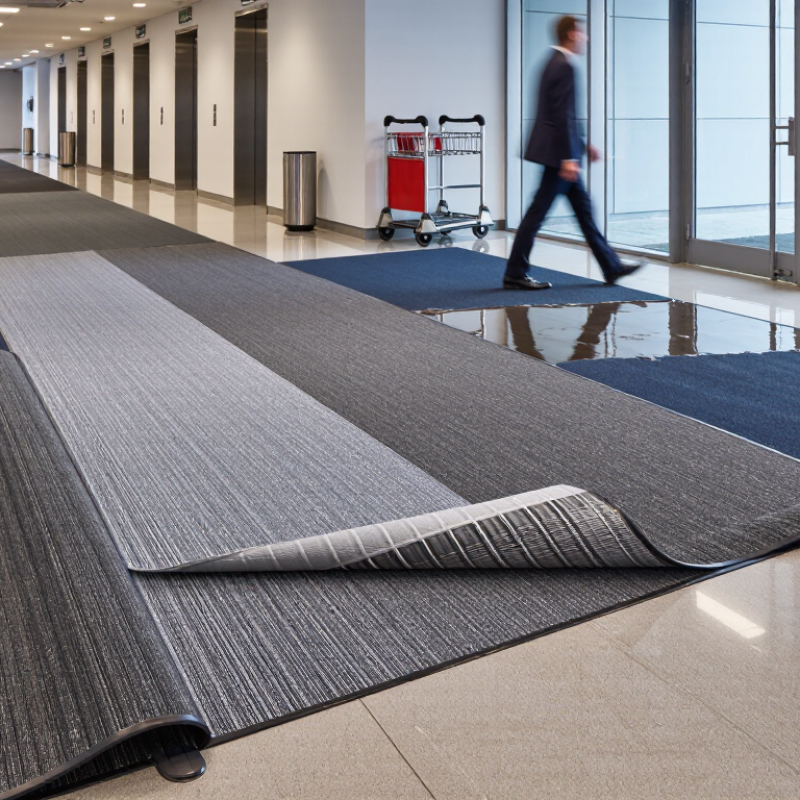
PVC carpet mats combine a textile-like surface with a flexible polyvinyl chloride backing. The surface captures dust and moisture near entrances. The PVC layer adds grip, shape stability, and easier cleaning. Buyers often choose them for offices, hotels, retail spaces, and commercial vehicles.
The market logic is clear. Grand View Research reported that the global PVC flooring market was valued at about USD 42 billion in 2023. It also expects steady growth through 2030, supported by renovation and commercial construction. PVC carpet mats represent only one segment, but this demand supports their supply chain. Raw-material access matters. So does consistent production.
Global buyers usually compare thickness, pile density, backing weight, edge finishing, and drainage performance. A practical sample should be tested after repeated rolling, washing, and foot traffic. ASTM and ISO-based slip-resistance tests can improve purchasing confidence. However, one test cannot predict every installation. Outdoor heat, oily entrances, and poor subfloor preparation can reduce service life. That detail is sometimes overlooked.
PVC mats are not maintenance-free. Dust still collects at the edges. Strong sunlight may cause fading over time. Responsible buyers should request material declarations, batch records, and independent test results. According to the European Commission’s 2023 circular economy monitoring, resource efficiency remains important across manufactured products. Recycled PVC content may help, but it should never replace verified performance.
A practical comparison table covering PVC carpet mat construction, performance, applications, purchasing factors, and international sourcing considerations.
| Data Dimension | Typical Specification or Fact | What It Means for Global Buyers | Common Applications | Key Evaluation Points |
|---|---|---|---|---|
| Product Definition | A floor covering made with a PVC backing, PVC surface structure, or a PVC base combined with carpet fibers. | PVC provides a water-resistant, flexible, and comparatively easy-to-clean foundation. | Entrance areas, corridors, offices, retail stores, hotels, schools, and vehicles. | Confirm whether the product is PVC-backed carpet, PVC loop mat, PVC coil mat, or a textile mat with PVC edging. |
| Surface Construction | Common surfaces include needle-punched fibers, polypropylene carpet, polyester fibers, PVC coils, or molded PVC patterns. | Surface construction affects dirt capture, comfort, drying speed, and maintenance requirements. | Indoor entrance mats, commercial carpet runners, anti-slip floor mats, and utility areas. | Request surface-material details, pile or coil height, fiber density, and cleaning instructions. |
| Backing Function | PVC backing is commonly used to improve dimensional stability, moisture resistance, and contact with the floor. | The backing helps reduce movement and protects the floor from moisture passing through the mat. | Building entrances, wet-weather areas, kitchens, elevators, and high-traffic walkways. | Check backing thickness, edge finishing, flexibility at low temperatures, and compatibility with the target floor. |
| Typical Thickness | Commercial PVC carpet mats are commonly produced in several thickness options, often approximately 3–12 mm depending on construction. | Thicker mats may offer more cushioning and dirt capacity but can create clearance issues beneath doors. | Low-profile office mats, heavy-duty entrance mats, modular floor coverings, and vehicle mats. | Match thickness with door clearance, rolling equipment, storage requirements, and installation method. |
| Standard Widths and Lengths | Roll goods and finished mats are available in multiple widths and cut-to-length formats; exact sizes vary by supplier and construction. | Roll formats can reduce seams and simplify large-area installation, while finished sizes support retail and replacement sales. | Long corridors, entrance vestibules, elevators, hotel lobbies, and residential doorways. | Confirm maximum roll width, cutting tolerance, packaging dimensions, and container-loading efficiency. |
| Water Resistance | PVC itself has low water absorption compared with many natural floor-covering materials, although the complete mat may still retain water in its fibers. | Useful for wet climates and entrances, but water management depends on the surface, backing, and drainage design. | Rainy-season entrances, poolside support areas, washrooms, kitchens, and covered outdoor spaces. | Ask for water-drainage behavior, drying recommendations, and whether the product is intended for indoor or outdoor use. |
| Slip Resistance | Textured PVC surfaces and rubber-like PVC backings can improve traction, but performance depends on floor condition and test method. | Slip resistance is especially important where moisture, dust, or frequent foot traffic is expected. | Commercial entrances, supermarkets, hospitality facilities, factories, and public buildings. | Request test results using a recognized method and identify whether testing was performed on dry, wet, or contaminated floors. |
| Dirt and Moisture Capture | Textile or looped surfaces can scrape particles from footwear and retain some moisture before it reaches the floor. | A properly selected entrance mat can help reduce tracked-in soil and floor-maintenance frequency. | Building entrances, shopping centers, hotels, airports, and office reception areas. | Evaluate fiber design, pile density, mat length, cleaning frequency, and expected traffic volume. |
| Cleaning and Maintenance | Typical care may include vacuuming, brushing, spot cleaning, damp mopping, or low-pressure washing, depending on construction. | Simple maintenance can lower labor requirements and extend service life. | Retail, education, healthcare support areas, offices, transport facilities, and hospitality venues. | Verify resistance to detergents, recommended water temperature, drying time, and whether machine cleaning is permitted. |
| Durability Factors | Service life depends on traffic intensity, UV exposure, abrasion, moisture, cleaning practices, and floor conditions. | There is no single service-life figure that applies to every PVC carpet mat; application conditions are decisive. | High-traffic commercial buildings, warehouses, institutions, and residential areas. | Review abrasion data, edge strength, dimensional stability, colorfastness, and previous use-case references. |
| Temperature Considerations | PVC flexibility and dimensional stability vary by formulation; very low or high temperatures can affect handling and use. | Export buyers should select a formulation suitable for the destination climate and transport conditions. | Cold-climate logistics, warm-weather entrances, vehicles, covered outdoor areas, and industrial facilities. | Request storage limits, operating-temperature guidance, and low-temperature flexibility information. |
| Customization Options | Common options include color, pattern, dimensions, edging, logo integration, surface texture, and packaging. | Customization supports local retail requirements, facility branding, and project-specific dimensions. | Hotels, retail chains, corporate offices, schools, exhibitions, and promotional programs. | Confirm minimum order quantity, artwork requirements, color tolerance, sampling process, and mold or tooling charges. |
| Packaging and Logistics | Mats may be packed flat, rolled, bundled, or palletized according to size, thickness, and risk of deformation. | Packaging affects freight cost, warehouse space, moisture protection, and arrival condition. | Container shipments, e-commerce fulfillment, distributor warehouses, and project deliveries. | Check carton dimensions, pallet pattern, gross weight, compression protection, labeling, and container-loading quantity. |
| Material Compliance | Requirements vary by destination and may address restricted substances, chemical content, fire behavior, indoor emissions, or packaging materials. | Compliance documentation reduces customs, project-approval, and retailer-onboarding risks. | Public buildings, commercial developments, institutional projects, and regulated retail channels. | Identify destination-country rules and request applicable declarations, laboratory reports, safety data, and test certificates. |
| Fire Performance | Fire behavior depends on the complete product, including PVC formulation, fibers, backing, and construction. | Some commercial projects require a specified fire classification before approval. | Hotels, offices, transportation buildings, schools, healthcare facilities, and public venues. | Do not rely on a generic material claim; request product-specific testing to the standard required by the project. |
| Sustainability Considerations | PVC products can be durable and long-lasting, but environmental performance depends on formulation, additives, service life, and end-of-life handling. | Buyers increasingly compare durability, recycled content, transparency of additives, and recycling pathways. | Green-building projects, commercial fit-outs, public procurement, and long-term facility management. | Ask for recycled-content information, product composition, environmental declarations where available, and disposal guidance. |
| Quality-Control Documents | Useful records may include dimensional inspection, weight or thickness data, color inspection, adhesion checks, and performance test reports. | Documented quality control supports repeat purchasing and reduces variation between production batches. | Distributor programs, chain-store supply, project orders, and private-label sourcing. | Agree on inspection criteria, acceptable tolerances, sample approval, batch traceability, and pre-shipment inspection. |
| Why Global Buyers Choose PVC Carpet Mats | They combine practical moisture resistance, flexible design options, relatively simple care, and suitability for many commercial environments. | PVC carpet mats can offer a balanced solution when buyers prioritize functionality, customization, and manageable logistics. | Commercial buildings, hospitality, education, retail, residential entrances, and transport-related facilities. | Compare total cost of ownership rather than unit price alone, including freight, cleaning, replacement, compliance, and installation costs. |
Note: Specifications such as thickness, dimensions, slip resistance, fire performance, and service life vary by product construction and market. Buyers should request current product-specific technical data and compliance documentation before placing an order.
They combine a textile-like surface with a flexible polyvinyl chloride backing. The surface traps dust and moisture near entrances. The backing improves grip, shape stability, and cleaning. They are common in offices, hotels, shops, and commercial vehicles.
Buyers value easy cleaning, stable dimensions, and practical moisture control. These mats also support large commercial projects and vehicle applications. Price matters, but performance matters more. Sometimes buyers notice this too late.
Compare total thickness, pile density, backing weight, edge finishing, drainage, and surface texture. Check whether the mat stays flat after rolling. Measure actual samples, not only catalog values. Small differences become visible across a large installation.
Test the sample after repeated rolling, washing, and heavy foot traffic. Check slipping, curling, fading, odor, and backing separation. Place it near a busy entrance for practical observation. One test cannot predict every location.
Strong sunlight may fade the surface over time. Oil, trapped grit, and poor subfloor preparation can cause damage. Outdoor heat may also affect flexibility and color. Maintenance is still necessary.
Request material declarations, recycled-content records, batch information, and independent test results. Ask for results covering thickness, abrasion, slip resistance, odor, and dimensional stability. Review the certificate scope and audit date. Paperwork alone proves little.
Inspect samples under strong lighting. Look for bubbles, uneven backing, curled edges, and inconsistent colors. Request samples from three separate production batches. That small check can expose weak process control.
Compare production scale, customization, packaging strength, delivery reliability, testing, and total landed cost. Large producers may offer stable volume and competitive pricing. Smaller suppliers may provide flexible dimensions or patterns. The cheapest quotation can still become expensive.
No. Recycled content may support resource efficiency, but verified performance remains essential. Ask for traceable composition records and batch documentation. A greener claim without reliable evidence is incomplete.
Yes. A pilot order can reveal color variation, odor, curling, weak edges, and packaging damage. Use an independent inspection plan before full production. Trust should be tested, not assumed.
Pvc Carpet Mat products are valued by global buyers for their durability, water resistance, slip-reducing surfaces, and easy maintenance. They are commonly used in entrances, commercial buildings, vehicles, workshops, and other high-traffic areas. When evaluating manufacturers, buyers should consider raw material quality, production capacity, dimensional accuracy, surface design, backing performance, quality-control procedures, and experience with international orders. Regional suppliers may differ in their strengths, such as large-scale production, flexible customization, fast delivery, or specialized designs for specific markets.
A reliable comparison should cover product thickness, wear resistance, color stability, packaging, private-label options, mold development, and available safety or environmental certifications. Buyers should also request samples and inspection records before placing large orders. Pricing should be assessed together with tooling, packaging, minimum order quantities, shipping terms, customs requirements, and lead times. Choosing a supplier with clear communication, stable capacity, transparent documentation, and responsive after-sales support can help global buyers reduce purchasing risks and build a dependable long-term supply relationship.

 YUNIS Trading