Choosing China’s top Sink Floor Mat suppliers requires more than comparing catalog prices. The right supplier must balance material safety, drainage, comfort, production consistency, and delivery performance. Grand View Research’s home textiles market analysis identifies durability, hygiene, and functional design as important purchasing factors. These priorities apply directly to mats placed beside wet sinks.
China remains a major manufacturing base for household textile and rubber products. The National Bureau of Statistics of China regularly reports strong industrial production capacity, but factory scale alone does not prove supplier reliability. Buyers should examine audited quality systems, material specifications, sample results, and export experience. A practical review should check whether the mat returns to shape after compression, resists curling at the corners, and dries quickly after water exposure. Small details matter.
Look closely.
Intertek and SGS testing services commonly evaluate products for physical performance, restricted substances, and colorfastness. OEKO-TEX certification can also support claims about textile safety, although buyers should verify certificate scope and validity. These documents cannot replace firsthand inspection. Requesting a pre-production sample and a final random inspection can reveal uneven stitching, weak backing, or inaccurate dimensions.
No supplier is perfect. Even experienced factories may struggle with peak-season capacity or customized packaging. This is where transparent communication becomes valuable. The best China Sink Floor Mat supplier should provide clear lead times, traceable materials, responsive quality support, and realistic product claims. This guide compares those practical indicators, helping importers choose a dependable partner rather than simply selecting the lowest quotation.
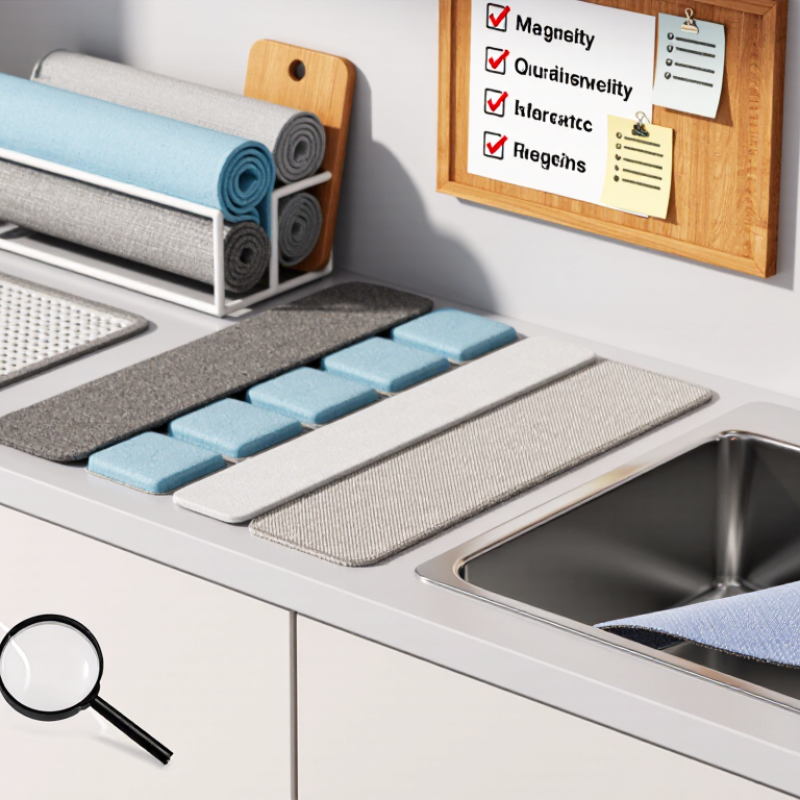
A reliable sink floor mat supplier in China should offer more than attractive prices. During supplier evaluations, inspect product samples closely. Check the mat’s thickness, edge sealing, drainage holes, and surface grip. A kitchen mat should remain stable on wet tiles and resist daily splashes.
Ask for clear material specifications. PVC, rubber, and composite materials behave differently under heat, moisture, and cleaning chemicals. Experienced suppliers can explain these differences without vague promises. They should also provide production photos, inspection records, and sample measurements. Small details matter. A two-millimeter size error may leave water around the cabinet base.
Factory communication is another practical test. Reliable teams answer questions directly and confirm artwork, dimensions, packaging, and delivery dates in writing. They should explain their quality-control process before mass production begins. Independent testing may also help verify slip resistance, odor levels, and material safety where required. Do not rely only on a polished catalog.
A strong supplier should handle defects honestly. Ask how they replace damaged goods and record corrective actions. The cheapest quotation is not always the lowest cost. Weak packaging can create curled edges, stains, or broken corners during transport. Still, no supplier is perfect. A thoughtful buyer should compare samples, documentation, response speed, and factory capacity before making a decision.
China Top Sink Floor Mat Suppliers Which Should You Choose?
Sink floor mats differ in material, structure, and drying speed. PVC mats are affordable, flexible, and easy to rinse. Rubber mats offer stronger grip, especially on wet ceramic floors. Diatomaceous stone mats absorb splashes quickly and feel firm underfoot. Microfiber mats provide softness, but they need frequent washing. Some models use raised channels to guide water away from the sink. Others use perforated surfaces for faster drainage. Each type solves a different household problem.
The 2024 Grand View Research flooring market report shows continued demand for durable, water-resistant household surfaces. Safety matters too. The U.S. Consumer Product Safety Commission regularly identifies wet floors as a common fall hazard. These reports support choosing mats with textured backing and stable edges. For Chinese suppliers, request material specifications, slip-resistance test results, thickness data, and washing instructions. A thick mat is not automatically safer. I have seen bulky designs hold water underneath, which can damage sensitive flooring over time.
Tips: Match the mat to your floor first. Choose rubber for smooth tiles and microfiber for frequent washing. Check whether the backing remains flat after drying. Ask for sample testing before placing a larger order. A small detail matters. No mat performs perfectly in every kitchen, so drainage and cleaning habits still require honest attention.
Common sink floor mat formats are compared by width and length in centimeters. PVC mats are valued for waterproofing and easy cleaning, TPE mats provide flexible non-slip performance, rubber mats offer strong grip and durability, and microfiber mats are selected for water absorption and quick drying. Choose the size and material according to cabinet clearance, floor area, moisture level, and cleaning requirements.
Choosing a Chinese sink floor mat supplier requires more than comparing prices. A reliable evaluation begins with product samples and factory evidence. Request mats in different sizes, then check edge sealing, drainage holes, surface grip, and flexibility. Place one under a wet sink for several days. Watch for curling, staining, odor, or trapped water.
Ask the manufacturer for material specifications, production photographs, and recent quality inspection records. Independent laboratory reports are more useful than vague claims about premium materials. Confirm whether the report matches the exact product and material you will purchase. Check thickness with a ruler and test how the mat recovers after being folded. Small details often reveal weak process control.
Supplier communication also matters. Ask about mold ownership, minimum order quantities, replacement procedures, and lead times in writing. A video factory tour can help, but it cannot replace an onsite or independent audit.
Review packaging carefully. Wet mats need sealed inner bags, clear labels, and protection against deformation during shipping.
A common mistake is choosing the lowest quotation too quickly. I have seen buyers overlook inconsistent dimensions and unclear drainage design. My own evaluation would include a trial order, though even that has limits. One successful batch does not prove long-term consistency. Keep approved samples, inspection photos, and signed specifications for every repeat purchase.
China Top Sink Floor Mat Suppliers: Which Should You Choose?
Quality should be checked through details, not attractive product photos. A reliable sink floor mat should lie flat, resist curling, and drain water quickly. Inspect the surface texture, edge sealing, thickness, and slip resistance. Ask for material specifications and samples from different production batches. A practical sourcing lesson is simple: one sample can hide production variation. Request a small trial order before committing to large volumes. It may cost more initially.
Pricing requires more than comparing unit quotations. Include mold fees, packaging, inspection charges, shipping, and possible replacement costs. A cheaper mat may use thinner material or weaker backing. Compare the usable service life, not only the purchase price. Ask suppliers to explain minimum order quantities and payment terms clearly. I would also request a written quotation with the same specifications. Otherwise, comparisons become unreliable.
Customization can include size, color, drainage holes, texture, packaging, and private labeling. Confirm whether custom molds require separate charges and ownership terms. Certifications need equal attention. Request current test reports, factory quality certificates, and material safety documents. Check the testing laboratory, report date, product model, and matching material. Requirements differ by destination market. A certificate without traceable details is not enough. Some decisions remain imperfect, especially when delivery speed conflicts with inspection depth. That trade-off deserves careful discussion with the supplier.
Choosing a China sink floor mat supplier starts with your working conditions, not a catalog photo. Measure the sink area, drainage path, and clearance beneath cabinets. A mat for a busy restaurant needs stronger edges than one for a quiet home. In my sourcing experience, silicone and flexible PVC are common choices. Silicone usually handles heat better, while PVC can offer a lower purchase cost. Ask for material specifications, hardness data, odor testing, and slip-resistance results. Photos are useful, but physical samples reveal surface texture and drainage performance.
The best supplier should explain production controls clearly. Request sample approval, batch inspection records, packaging details, and replacement procedures for damaged goods. Check whether dimensions stay consistent across several samples. Small errors can create standing water or a poor cabinet fit. I once focused too heavily on unit price and overlooked carton strength. That decision caused avoidable handling problems. A reliable supplier should answer technical questions directly, confirm lead times in writing, and admit limitations. Perfect promises deserve careful review.
Tips: Compare three samples under real conditions. Pour water across each mat and inspect drainage after five minutes. Press the edges, check odor, and measure thickness. Ask about minimum order quantity and customization costs. Keep all agreed specifications in one document. A short video call can also expose unclear workmanship.
| Supplier Profile | Primary Manufacturing Strength | Common Materials | Typical Product Formats | Indicative MOQ | Typical Sample Lead Time | Typical Bulk Lead Time | Customization Capability | Quality and Compliance Focus | Best Fit for Buyers |
|---|---|---|---|---|---|---|---|---|---|
| Profile A ★★★★★ |
High-volume production for standard kitchen and bathroom floor mats | PVC TPE Polyester | Rectangular sink mats, runner mats, draining mats, and anti-slip utility mats | 500–1,000 pieces per design | 7–12 calendar days | 25–40 calendar days after approval | Printed packaging, private labels, standard color matching, and several stock sizes | Slip-resistance testing, dimensional inspection, odor checking, carton inspection, and material verification | Importers seeking competitive pricing and stable repeat production |
| Profile B ★★★★★ |
Premium silicone and soft-touch mat manufacturing | Silicone TPE Rubber | Flexible U-shaped sink mats, countertop protection mats, and custom molded drainage mats | 300–800 pieces per design | 10–15 calendar days | 30–45 calendar days after sample approval | Custom molds, embossed logos, drainage channels, edge profiles, colors, and retail packaging | Material safety documentation, heat-resistance checks, anti-slip performance, and mold consistency control | Retail brands and distributors targeting a higher-value product range |
| Profile C ★★★★☆ |
Textile-based absorbent mat production with flexible design options | Polyester Polyamide Rubber backing | Absorbent sink mats, kitchen runners, microfiber mats, and washable floor mats | 1,000–2,000 pieces per color | 8–14 calendar days | 30–45 calendar days after artwork and sample approval | Digital printing, woven labels, edge binding, custom dimensions, and packaging inserts | Colorfastness, water absorption, backing adhesion, wash durability, and stitching inspection | Household retailers that prioritize absorbency, softness, and design variety |
| Profile D ★★★★☆ |
Heavy-duty PVC and rubber utility mat production | PVC Nitrile rubber TPR | Thick anti-fatigue mats, waterproof sink mats, commercial utility mats, and textured drainage mats | 300–600 pieces per size | 12–18 calendar days | 35–50 calendar days after technical confirmation | Thickness, surface texture, beveled edges, drainage patterns, color, and die-cut dimensions | Tensile strength, abrasion resistance, slip resistance, thickness tolerance, and odor control | Commercial kitchens, hospitality projects, and buyers needing durable products |
| Profile E ★★★★☆ |
Small-batch and private-label production for online and specialty retailers | Silicone PVC Microfiber | Compact sink mats, foldable mats, seasonal designs, and gift-ready product sets | 100–300 pieces per SKU | 5–10 calendar days | 20–35 calendar days after artwork approval | Low-volume packaging, barcode labels, bundled sets, color combinations, and online-ready cartons | Appearance inspection, packaging checks, barcode verification, basic slip testing, and sample comparison | Start-ups, e-commerce sellers, and buyers testing new designs |
| Profile F ★★★★☆ |
Export-oriented mixed-material production with consolidated shipment support | PVC TPE Polyester Silicone | Mixed-material sink mat collections, multi-size assortments, and coordinated kitchen accessories | 500–1,000 pieces per style | 10–16 calendar days | 30–45 calendar days after final confirmation | Mixed-color assortments, coordinated collections, export cartons, manuals, and multilingual labels | Pre-shipment inspection, carton drop testing, packing-list verification, and export documentation review | Overseas wholesalers needing several product categories in one shipment |
Note: MOQ and lead-time figures are indicative sourcing benchmarks for comparable Chinese sink floor mat manufacturers. Confirm current pricing, material specifications, testing documents, production capacity, and delivery schedules directly before placing an order.
Common options include PVC, rubber, stone-based absorbent, and microfiber mats. Each material handles water, comfort, and cleaning differently.
Rubber usually provides stronger grip on wet ceramic surfaces. Choose textured backing and stable edges. Test it wet.
No. Thick mats can trap water underneath and damage sensitive flooring. Check drainage, backing stability, and drying performance instead.
Raised channels guide splashes away from the sink. Perforated surfaces let water drain faster. Both designs still need regular cleaning.
Microfiber mats are soft and washable, but they may require frequent cleaning. Flexible PVC is also easy to rinse.
Choose stronger edges, reliable drainage, and durable materials. Measure the sink area and cabinet clearance before ordering. Conditions matter more than photos.
Request material details, hardness data, thickness measurements, odor testing, and slip-resistance results. Ask for washing instructions and physical samples.
Pour water across each sample and inspect drainage after five minutes. Press the edges, check the odor, and measure thickness. Record every result.
Confirm production controls, batch inspections, packaging strength, replacement procedures, and written lead times. Perfect promises deserve careful review. I learned that late.
Choosing the right China Sink Floor Mat supplier requires more than comparing prices. A reliable supplier should offer stable production capacity, consistent quality control, responsive communication, and clear product specifications. Buyers can choose from absorbent fabric mats, quick-drying diatomaceous-style mats, rubber-backed anti-slip mats, and waterproof PVC options, depending on kitchen conditions and customer preferences. Important features include water absorption, fast drying, slip resistance, durability, easy cleaning, and resistance to mold and odors.
When evaluating suppliers and manufacturers, compare material quality, production processes, customization services, packaging options, minimum order quantities, lead times, and total costs. Certifications and inspection reports can also help confirm product safety and manufacturing reliability. The best supplier is not always the one offering the lowest quotation, but the one that provides a suitable balance of quality, pricing, customization, delivery performance, and professional support. By matching these factors with your target market and purchasing needs, you can select a dependable Sink Floor Mat supplier for long-term cooperation.

YUNIS Trading